The first wage-weighted H-1B lottery is done. The system worked roughly as designed: Level III and IV registrations were selected at dramatically higher rates than Level I. But one dimension of the new system has drawn less attention than it deserves — geography.
The weighted system ties your lottery entries to your DOL wage level, which is determined by your offered salary relative to the prevailing wage for your occupation in your specific metro area. That last part matters more than most people realize. Because prevailing wages vary enormously by location, the same salary can yield very different lottery odds depending on where the job sits.
This is not a bug. DHS says it's a feature. But the practical effect is that location has become a silent variable in H-1B selection — and employers in smaller, cheaper markets may hold a structural edge that the old random lottery never gave them.
The Mechanics: How Location Sets the Bar
The Department of Labor's Occupational Employment and Wage Statistics (OEWS) program produces wage estimates for roughly 830 occupations in every metropolitan statistical area in the country. For each occupation and geography, DOL sets four wage levels. Level I sits at roughly the 17th percentile of the local wage distribution. Level IV sits at roughly the 67th percentile.
Under the weighted lottery rule — finalized December 29, 2025 and effective February 27, 2026 — each H-1B registration receives lottery entries equal to its wage level: one entry for Level I, two for Level II, three for Level III, four for Level IV. DHS projected selection odds of roughly 15% for Level I, 31% for Level II, 46% for Level III, and 61% for Level IV.
The critical detail: wage levels are calculated locally. A software developer position (SOC 15-1252) doesn't have one national wage scale. It has hundreds, one for each metro area. And the gaps between them are enormous.
The Numbers Tell the Story
Consider a software developer (SOC 15-1252) — the single most common H-1B occupation, accounting for a dominant share of the roughly 326,000 petitions filed under SOC major group 15 from FY 2020–2024. Here is what Level IV — the highest tier, carrying four lottery entries — looks like across different metro areas under the current OEWS data:
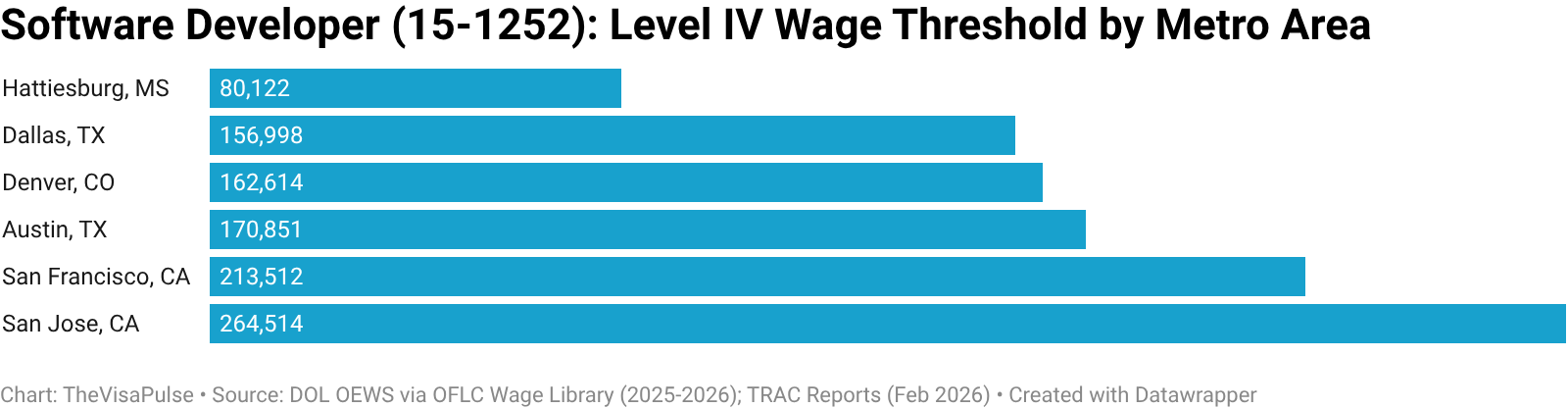
A company in Hattiesburg, Mississippi can reach Level IV — and get four lottery entries — by offering $80,122 per year. A company in San Jose, California needs to offer $264,514 for the same number of entries in the same occupation. That is a difference of $184,392 for the same lottery advantage.
Put another way: a software developer earning $150,000 in San Francisco might qualify for Level II or III, depending on exact thresholds. That same $150,000 in Austin likely qualifies for Level III. In Dallas, it could approach Level IV. In Hattiesburg, it exceeds Level IV by nearly double.
This pattern holds across occupations. The OEWS data, by design, tracks local labor markets. In high-cost metros where tech workers command top dollar, the prevailing wage distribution is compressed upward. In smaller markets, the whole curve sits lower.
DHS Says the System Is Neutral
DHS addressed geographic concerns directly in the final rule. The agency stated that the rule "neutralizes geographic differences in salary amounts by taking into account the area of intended employment when weighting registrations." The logic: because wage levels measure your pay relative to the local market, a Level III in Hattiesburg represents the same relative position as a Level III in San Jose. Both reflect experienced workers paid at or above the local 50th percentile.
The rule also includes an anti-gaming provision for multi-location positions. When a worker will be employed in multiple locations, the employer must select the lowest wage level across all sites. A $175,000 salary that exceeds Level IV in Sacramento but only qualifies for Level II in San Francisco must be registered at Level II.
And USCIS reserved the authority to deny or revoke petitions where an employer changed locations post-selection in ways that appear designed to manipulate odds.
The Critics' Argument: "Neutral" Misses the Point
Analysts have pushed back on the geographic neutrality claim from multiple angles.
TRAC Reports, in a February 2026 analysis of the H-1B wage level rule, noted that the system "leaves unaddressed concerns that employers will attempt to manipulate the wage level process in advance of registration by relocating positions from higher cost metropolitan areas to lower cost rural areas for purposes of raising the wage level for a position while simultaneously reducing salary levels."
TRAC illustrated the point with the Hattiesburg-to-San Jose comparison: an employer could relocate a software developer position from San Jose to Dallas, cut the salary from $264,514 to $156,998, still reach Level IV, and save $107,516 — enough to cover the $100,000 H-1B fee with money left over. The savings and the lottery advantage compound.
The final rule's enforcement tools target post-registration location changes. They do not address an employer's decision to locate a position in a lower-cost area before registration. If the job legitimately exists in Dallas, the registration is valid — even if the employer chose Dallas partly because it offered better lottery math.
Jeremy Neufeld, Director of Immigration Policy at the Institute for Progress, made a related critique in his September 2025 analysis of the proposed rule. His research, based on FOIA data covering all H-1B registrations from FY 2021–2024, found that the wage level framework "was never designed to compare wages across occupations because it measures relative seniority within a job category, not actual pay." Some Level IV jobs pay below the national median wage, while some Level I and II jobs are among the best-paid in the economy.
What This Means in Practice
For employers already located in smaller markets, the wage-weighted system is a genuine structural advantage. A tech company in Boise, Omaha, or Raleigh can reach Level III or IV at salary points that would barely qualify for Level II in San Francisco or New York. Their lottery odds improve accordingly — potentially doubling or tripling relative to a coastal competitor offering the same or higher absolute salary.
For large employers with geographic flexibility, the system creates new incentives to think about where H-1B positions are based. This doesn't require fraud or gaming. A company deciding between locating a development team in San Jose versus Austin now has an additional variable in the calculation: lottery odds.
For employers in rural areas, the picture is more complicated. The National Immigration Forum flagged that "essential positions with lower wages — such as entry-level and rural positions — could receive fewer visas" and that "industries that rely on entry-level or modestly paid skilled workers in rural areas may find it harder to compete." A hospital in rural Nebraska or a school district in Appalachia still needs to reach Level III or IV to get meaningful lottery odds — and in healthcare or education, even local Level III wages may exceed what the employer can pay. The wage thresholds are lower in absolute terms, but rural budgets are lower too.
The $100,000 H-1B fee for workers outside the U.S. compounds this. Rural and economically disadvantaged areas "which frequently rely on international professionals to support essential sectors such as healthcare and education, are likely to face increasing labor shortages," as immigration firm Reddy Neumann Brown noted in a March 2026 analysis.
The Bigger Picture
DHS acknowledged in the final rule that 5,193 small entities — 30 percent of the 17,069 small entities filing H-1B cap-subject petitions — would be significantly affected by the rule, either through lost Level I selections or increased costs. The agency accepted this as a necessary cost of favoring higher-wage positions.
Early data from the FY 2027 lottery suggests the system tilted even more sharply than DHS projected. One immigration law firm reported client selection rates of 24.5% at Level I (versus DHS's projected 15.3%), 50.0% at Level II (versus 30.6%), and 69.2% at Level III (versus 45.9%). The overall pool dynamics shifted — likely because the $100,000 fee reduced overall registration volume, lifting all selection rates while preserving the relative advantage of higher wage levels.
So, how important is being in a small city? It depends on who you are.
If you're a tech employer choosing between office locations, the wage-weighted system has made geography a material factor in H-1B strategy for the first time. The same salary buys significantly better lottery odds in a lower-cost metro.
If you're a rural hospital or school district, the lower wage thresholds alone don't help much if your budget can't reach Level III in your area.
And if you're a foreign national weighing job offers, the location of the position now directly affects your probability of selection — in ways that have nothing to do with the salary number on your offer letter.
The old lottery was simple: everyone got the same odds. The new system is more complex, and geography is one of the variables that makes it so. DHS designed it to be neutral. Whether it stays that way depends on how employers respond.
Primary sources: DHS Final Rule, "Weighted Selection Process for Registrants and Petitioners Seeking To File Cap-Subject H-1B Petitions," 90 Fed. Reg. 60864 (Dec. 29, 2025); DOL OEWS wage data via OFLC Online Wage Library (2025–2026); TRAC Reports, "Fundamental Changes to H-1B Visas" (Feb. 2026); Institute for Progress, "The Wage Level Mirage" (Sept. 2025); National Immigration Forum, "Explainer: H-1B Rule Replaces Random Lottery System" (Jan. 2026).